

Delivering the New Youth Strategy – how funding can be targeted to reach youthwork ‘black holes’
At the end of 2025, the Government published their new £500m Youth Strategy, ‘Youth Matters’, including significant funding for building, refurbishing and equipping youth centres. This ambitious strategy, backed by substantial investment, builds on the work SIB has been delivering on behalf of the UK Government since 2022, including the £300m Youth Investment Fund (YIF) and £30.5m in the first phase of Better Youth Spaces (BYS). With 1 in 7 young people now within walking distance of a YIF-funded new or improved youth facility, the new strategy will expand this even further to reverse ‘years of decline’ in the sector.
The success of this new funding depends on reaching the right places: those with greatest need and without adequate provision. Yet one of the biggest challenges to understanding youth provision is the lack of a consistent national dataset showing where these services exist or how they relate to local need.
Mapping the challenge
Our new research, launching today, maps youth provision and youth need for the first time, identifying the ‘black holes for youth work’ across England through a new Unmet Need Index.
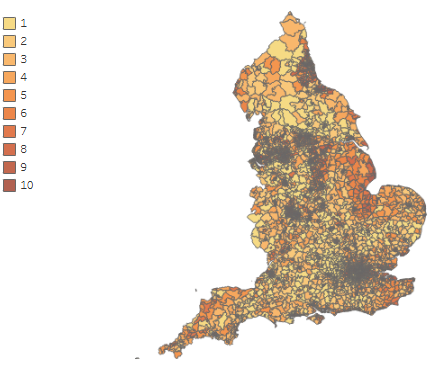
Figure Notes: Darker shades indicate higher unmet youth need, with Decile 10 representing areas with the highest unmet need.
This interactive online mapping was developed in partnership with the Masters Dissertation Scheme and demonstrates a nationwide challenge – nearly half of Local Authorities in England have at least one neighbourhood in the highest decile for unmet need.
However, some areas face a much higher concentration of these, including parts of the North East, North West, East Midlands and London, as well as a challenge among coastal communities, from Penzance to Thanet to Blyth.
Existing youth provision also appears to respond more to areas with higher levels of anti-social behaviour than to deprivation, perhaps suggesting that services may be more often directed towards places where issues are more visible, rather than where underlying socio-economic disadvantage is greatest.
The new Unmet Need Index brings together IDACI (deprivation affecting children) and anti-social behaviour data, to assess high need, and combines that with Charity Commission and Companies House registers to identify over 20,000 organisations likely to provide youth-related activities across England.
‘Youth Matters’ is an ambitious strategy, not only for its long-term vision but it’s commitment to immediate action and backing that with substantial funding. Success now depends on getting the right funding to the right places. A data-led approach will be critical for young people in areas of high need, without adequate provision, to feel the impact of this new Youth Strategy.
–> Explore the interactive maps and data
Irtania Ismira Dewi, the Data Analyst who led on this research for SIB, said:
“Until now, there’s been no clear national picture of where youth provision exists or where young people need support the most. And behind every data point is a young person looking for opportunity, a safe space, or someone to turn to.
This mapping aims to make that landscape visible, showing both where provision is concentrated and where gaps remain. The hope is that it gives policymakers and funders clearer information about youth need, so they can better target their support towards the communities that need it most.”
Bethia McNeil, Director of Quality and Impact at the YMCA, a leading national youth charity, said:
“This research from Social Investment Business is very welcome, as we wait for more detail on how the investment set out in the new youth strategy will benefit young people and communities. YMCA England & Wales’ research has charted the 73% decline in funding for youth services over the last 15 years, and this new analysis significantly advances our understanding of where services are reaching the young people who need them the most – and more importantly, where they are not.
This data-driven insight is vital, and should sharpen Government’s plans for targeted investment to eradicate these cold spots through creating new, welcoming spaces for young people, offering high quality opportunities and activities. Critically, this targeted investment in facilities needs to be matched with the funding to sustainably staff these spaces with skilled youth workers.”
Nick Temple OBE, Chief Executive at Social Investment Business, said:
“The challenge isn’t just providing more investment for youth services, but ensuring we’re led by the data to reach the communities that most need extra provision. Through our delivery of the government’s Youth Investment Fund, we’ve seen how targeted funding can transform access to safe, high-quality spaces for young people.
Today’s research shows there are still large gaps in provision – but gaps that can be closed through successful targeting and delivery of the funding announced through the new National Youth Strategy.”
More about the research
This new youth mapping research was carried out through the Master’s Dissertation Scheme supported by Social Investment Business (SIB). The research explored how publicly available data could be used to map youth provision across England and identify areas with less or no youth provision.
It combined data from the Charity Commission and Companies House registers to identify and map over 20,000 organisations likely to provide youth-related activities. These include charities, community interest companies (CICs), and other non-profit businesses. Because neither dataset directly labels youth organisations, several filtering methods were developed to identify those most likely to work with young people. Each resulting dataset was then mapped to MSOAs (Middle Layer Super Output Area), a consistent local geography with an average population of around 10,000. This was then converted into a youth provision rate per 1,000 young people to allow comparison between areas.
The recent updates to IDACI (Income Deprivation Affecting Children Index) are the first since 2019. This index measures the proportion of children (aged 0-15) living in income-deprived families and is often used to target funding, including in YIF and BYS, and which will be an important factor in designing the targeted and place-based funding outlined in the new National Youth Strategy. A lot has changed since the last update, including a new Government, a global pandemic and a cost of living crisis. This update provides an opportunity to reassess priority areas and align them with our research on existing youth provision and focus future investment for young people where the need and gaps are greatest.