

Designing the right finance for the right organisations
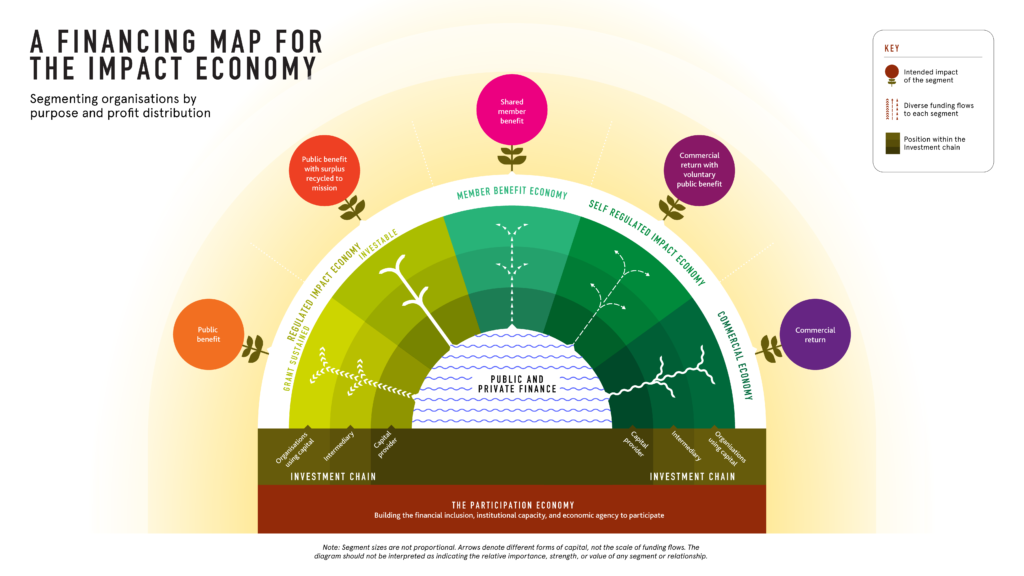
Today, in partnership with NPC, we are launching Segmenting the impact economy: A framework for directing finance effectively.
With the new government focusing squarely on devolution and good growth in every postcode, there is now a real opportunity for the impact economy to help deliver these ambitions, strengthening communities and building a fairer society.
The impact economy is growing in visibility and ambition. It’s an umbrella term bringing together all organisations seeking to create social or environmental benefit. Within this are a huge range of organisations, with very different financing needs. A foodbank, a charity with a trading arm, a co-operative and an impact-led business may all create public benefit, but their relationship with finance is fundamentally different.
Report author, David Neaum, said: “The impact economy needs clearer language if we want better decisions about policy, funding, finance and infrastructure. This framework is about matching different types of support to different organisational realities.”
Today’s new report unpacks these differences, with the aim of helping the right capital reach the right organisations, on terms that work.
Grant is not simply a stepping stone to investment
One of the most important elements is a distinction between organisations that can take on investment, and those that can’t.
While all charities, social enterprises, CICs and CBSs come with legal structures that protect their missions, and any surplus they produce, repayable finance will not be an appropriate tool for all of them.
For some organisations, grant can be seen as an early stage on the journey towards investment. While for others, it is the right and permanent form of funding.
A foodbank, peer-support service or community organisation may create enormous social value without ever generating the trading surplus needed to repay a loan. Treating them as simply “not yet investment ready” risks designing the wrong support around them. Segments 1 and 2 explore this distinction: the organisations within the ‘regulated impact economy’ that can take on investment, and those that can’t.
Different problems require different support
The framework also draws a crucial distinction between organisations that need ongoing grant funding, and those that need some grant subsidy to make repayable finance work.
For some organisations, their earned income cannot cover their costs. Grant funding is therefore the right tool, and ‘revenue subsidy’ is needed to support their ongoing work. Meanwhile, others can repay investment but need ‘capital subsidy’ to make that finance affordable, helping them to access repayable loans on terms they can manage.
Confusing revenue and capital subsidy, or seeing them both just as ‘grants’, creates poor policy. Offering debt to an organisation that can’t repay is ultimately just a grant dressed up as a loan. But relying on grants where an organisation could sustainably use investment can also hold back its ability to grow.
This is particularly important for social investors like us. ‘Investable’ is not a binary term: organisations have very different abilities to take on debt, and the report explores how grant, investment, and blends of the two, can be better matched to different parts of the market.
The opportunity for Government
At the central government level, the Office for Impact Economy, now in DCMS, and the Office for Investment, a joint unit of HM Treasury and DBIST, both have important roles in helping departments and Public Finance Institutions (PuFIns, such as National Wealth Fund or British Business Bank) understand the different segments of the impact economy. Together, they can help departments better understand who can deliver, at what scale, where, against which outcomes, and what capital they can actually use.
This understanding is just as important locally too. As Mayors and Strategic Authorities take on greater responsibility for growth and investment, they need a data-led understanding of the impact economy in their areas: which organisations can deliver against their priorities, at what scale and the types of finance and support each needs.
We’re seeing pockets of really promising collaboration, including with the Department for Education. Embedding this understanding across central government, Mayors and Strategic Authorities could enable a more consistent approach to partnership with the impact economy, delivering place-based impact at pace and scale rather than designing from first principles each time.
This report is the start of a conversation: offered to the sector and policymakers to test and explore. We look forward to hearing people’s challenges, thoughts and insights. In the coming months, we will publish more data analysis that explores and tests the definitions and dividing lines outlined in this report.