
How to understand the Impact Economy
For over twenty years, SIB has been putting finance to work for organisations that are building stronger communities and a fairer society. We’ve disbursed more than £0.8bn to 6,000 organisations and worked with a range of investors and partners. This experience, and the data and insights that come from it, have guided our approach to an exciting new project in partnership with NPC. Together, we’re developing a common framework that unpacks the impact economy more clearly, and where different kinds of finance and support are needed.
The transition to an impact economy is gaining real momentum. More people, organisations and institutions are coming together around a shared idea: that we can use money, policy and practical action to create positive change at a much bigger scale.
So, the big question is: how do we make the most of this moment? To do that, we need a shared approach, one that helps people speak the same language, understand where the gaps are, and work together to fill them.
Building on the scale NPC identified
NPC’s Impact UK work put a number on the Impact Economy as a whole: organisations built around positive impact generate £428 billion in gross value added, something like 15% of UK GDP. It’s a powerful headline figure, and we hope this joint framework can provide a way to ‘lift the bonnet’ and consider the distinct groups within that wider figure, the context in which they operate, and the funding, finance and support they need.
Two questions that do most of the work
The framework starts from two practical questions that shape what different organisations need and how they fit into the wider picture:
What rules govern profit distribution and where any surplus can flow?
Where does the organisation sit in the flow of money and investment?
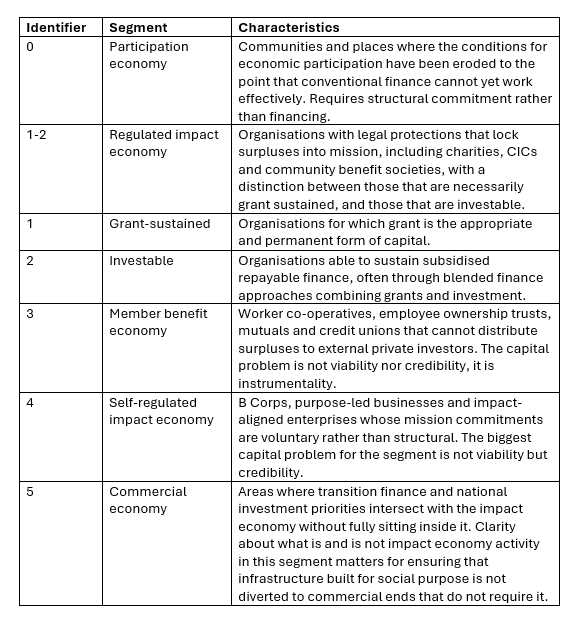
When we apply those questions, we can see the impact economy as made up of distinct segments. Each has different funding and financing needs, different barriers to accessing capital, and different market infrastructure requirements. But together they form one broader system.
Seeing these different segments as part of one connected system gives us a better chance of building a market that works. It helps us respect the differences between organisations while also spotting which funding and financing approaches are appropriate to them, and where shared tools, a common language and better coordination could make a real difference.
Six segments, one impact economy
Why SIB is investing in this framework?
This framework is not about ranking organisations or suggesting that one model is better than another. It is about matching the right kind of money to the right kind of organisation, so more people can succeed in creating impact. Not every organisation should be expected to become investable. Different organisations solve different problems and require different forms of support.
A framework like this works when it’s shared, argued with and tested. For investors, it suggests a structure for where different kinds of finance can help, where extra support is needed, and where existing tools do not yet fit. It enables us to see when subsidies are needed in different segments and what they unlock.
For policy makers, it is a practical way to think about where government can help unlock progress and build better partnerships across the system. It is a way of approaching co-designing solutions by beginning with the challenges faced by each segment.
What happens next
Behind this headline framework sits a more developed design architecture covering the different segments, which will launch in the coming weeks.
The framework is not intended as a finished answer. It is a starting point for discussion and further development. Over the coming months, we will be diving into the data from decades of social investment to test the assumptions and boundaries proposed by the framework, and how data-led insights can further build on this initial structure.
We also welcome discussion and feedback. We want to test this thinking with people across the sector. Together, we have a real opportunity to build an impact economy that works for all.
We’ll be sharing more over the coming weeks, including a full launch of the framework in partnership with NPC.